
Guide
Can one purchase combine Foreign Military Sales and Direct Commercial Sales?
An overall sale can be separated into a portion and a Direct Commercial Sales portion, and U.S. industry may request defense articles and services from the U.S. Government to support a .
Can one purchase combine Foreign Military Sales and Direct Commercial Sales?
In an international competition, the U.S. response may include , Direct Commercial Sales, an international cooperative agreement, or a combination of these programs. The partner releases its solicitation in the international market. When it is submitted through appropriate channels (Section C5.2.5), the solicitation counts as a . It starts U.S. Government processes, such as the National Disclosure Policy (), technology transfer and other reviews, that decide whether U.S. participation in the competition is in the U.S. best interest. Section C5.3 covers the response to such a request. Most foreign solicitations go to international defense industries rather than to governments, but the process should not be left out of the response solely because of how the solicitation was released or conditioned [SAMM ].
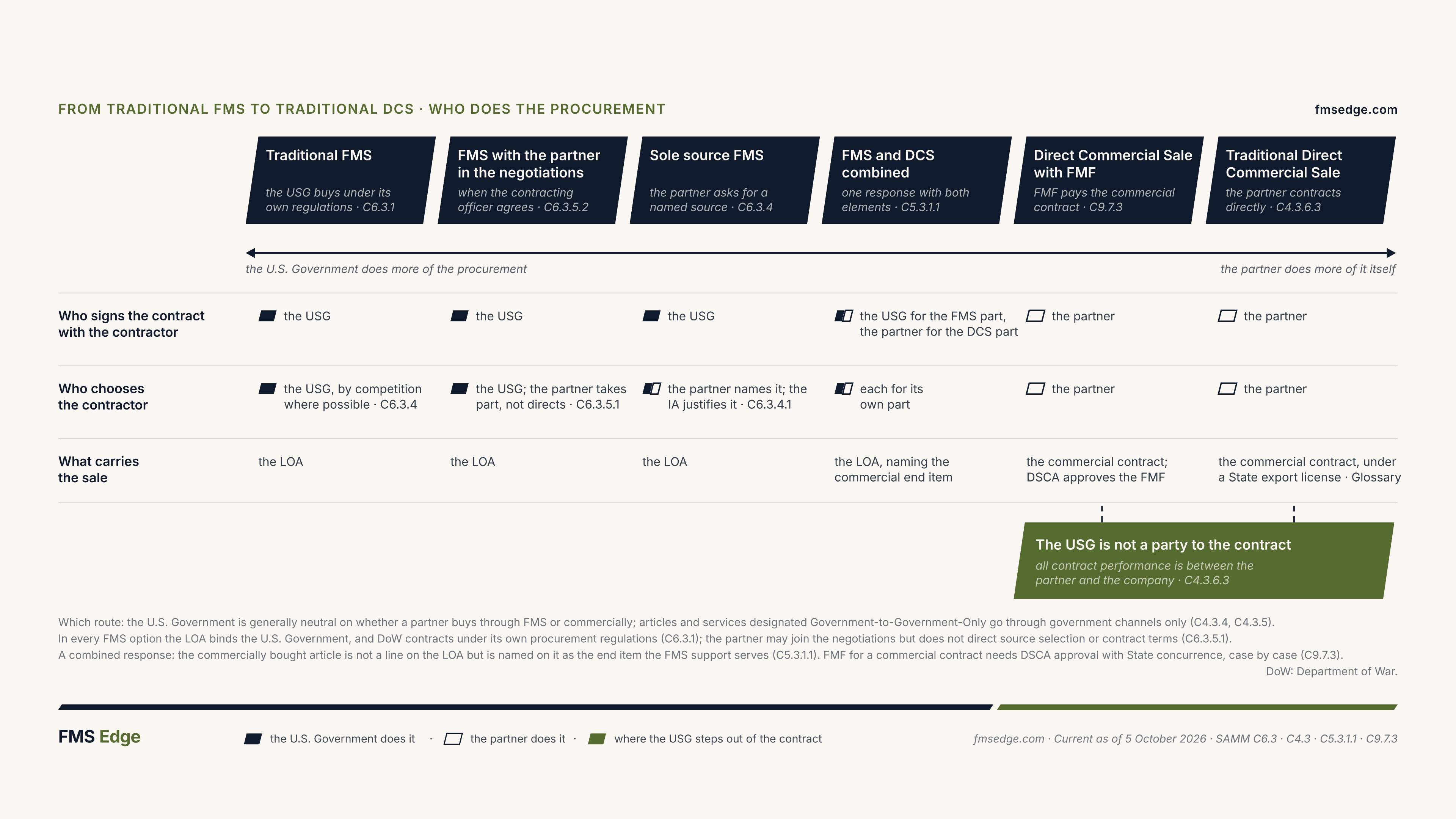
The comparison of and Direct Commercial Sales () is generally intended to evaluate the circumstances of a particular procurement to determine which method offers the greatest advantages. However, an overall sale can be separated into an portion and a portion as a hybrid response, which contains both and elements [SAMM ]. This means that an entire sale does not have to be simply because there is a Government-to-Government-Only (G2G-Only) component to the sale. The G2G-Only portion can be sold through the process, while the remainder of the sale proceeds on a basis. Close coordination ensures that the G2G-Only portion and the portion work together on delivery to the international partner.
In regard to materiel or services support for , advance planning and coordination are essential in any situation where industry anticipates requiring both and elements in order to fulfill the terms of a contract [SAMM , ]. The U.S. Government () is not bound to honor commitments made by industry. It also cannot be held liable when it is unable to provide support for a , even if the purchaser requests it. Industry should inform the international partner of articles or services required to support the purchased equipment. Industry should also tell the and the relevant when a sale may require articles or services. Examples of types of support for include training in U.S. military schools, airworthiness certification, aircraft ferrying, refueling services, or the provision of G2G-Only articles or services. The international partner must then submit a to obtain the required support [SAMM ].
Initial acquisition of a major system is just the beginning of the support the system needs throughout its life cycle. These systems will often be active in the international partners’ military inventory for more than a decade. Over this period of operational utility, a significant investment will also be made in the form of sustainment support. The method utilized to initially acquire a defense system does not obligate the international partners to obtain sustainment support for that system through the same original acquisition method.
Systems acquired by are eligible to obtain sustainment support for common support items [SAMM ]. Likewise, systems acquired by can be supported by if the international partner desires, except for any G2G-Only sustainment items.
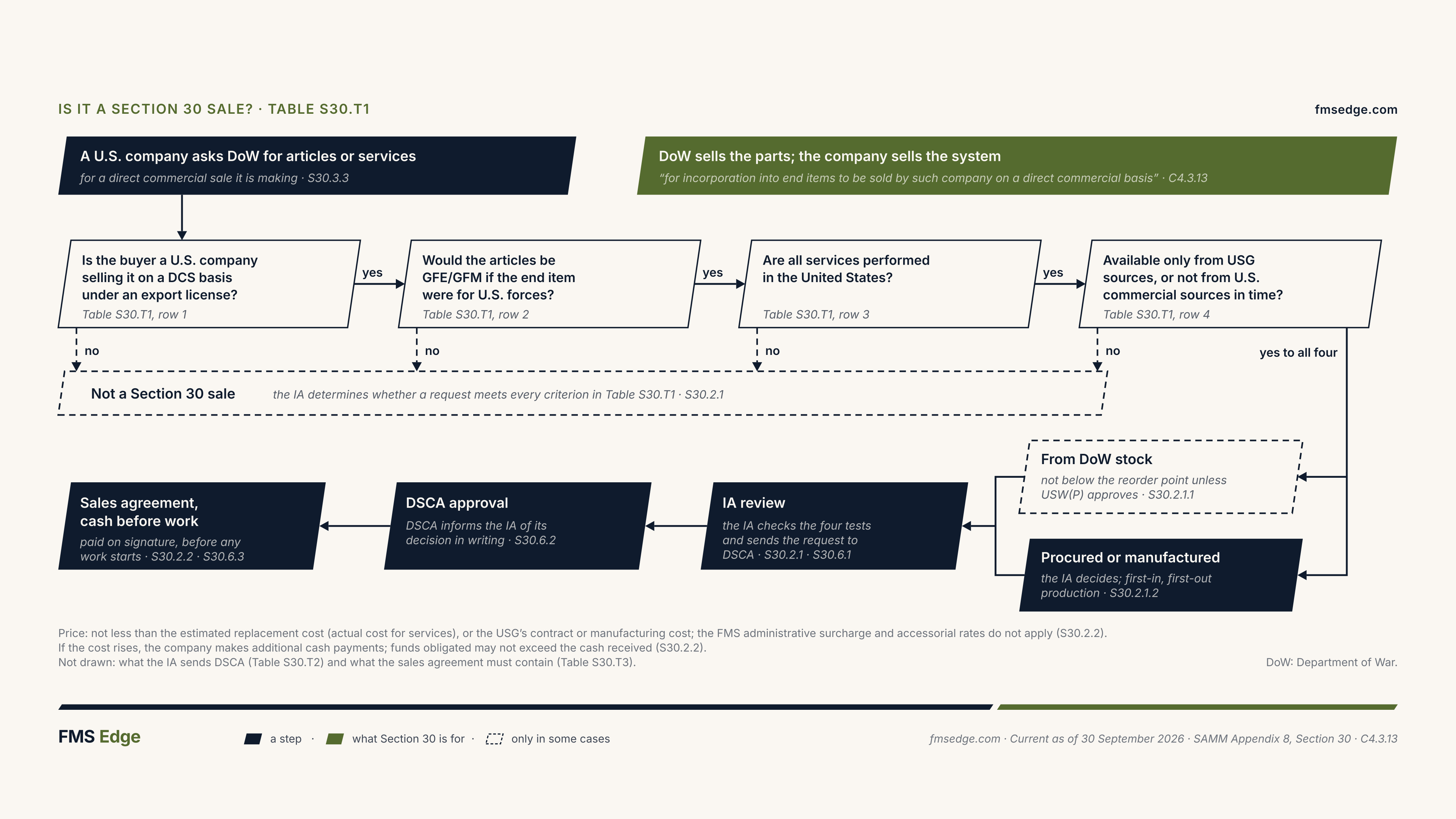
U.S. industry may ask the Department of War (DoW) for defense articles and services to support a to a partner or an international organization. Defense articles or services provided to U.S. industry must rest on an applicable statutory authority, including Section 30 of the . Section 30 authorizes selling defense articles or services to U.S. companies at no less than their estimated replacement cost (or actual cost, for services). The articles or services are for incorporation into end items that the company then sells directly, on a commercial basis, to a friendly partner or international organization [SAMM ] []. The Section 30 Sales part of Appendix 8 further clarifies what DoW support is authorized under Section 30. Defense industry representatives should identify early in planning whether DoW support will be required. If DoW support is deemed necessary, meetings with DoW representatives should be arranged to discuss the support level needed and how to fund the associated costs [SAMM ].
cases may be prepared to support elements of a procurement [SAMM ].
The hybrid option is particularly applicable to sales that may include certain G2G-Only items in the total system package.
Section 30 of the Arms Export Control Act lets the Department of War sell defense articles and services to a U.S. company for a direct commercial sale, if the request passes the four tests in SAMM Table S30.T1. DoW sells the parts; the company sells the system.
Six ways a partner can buy a U.S. defense article, from traditional Foreign Military Sales, where the U.S. Government signs and manages the contract, to the traditional Direct Commercial Sale, where the partner contracts with the U.S. company itself.
References
SAMM
- SAMM C5.3.1.1: Hybrid.
- SAMM C5.3.1: Types of Letter of Request Responses.
- SAMM C4.4.3: Logistics Support.
- SAMM C4.3.1.1: Foreign Solicitation.
- SAMM C4.3.13: Department of War Support to Direct Commercial Sales.
Public authorities
- AECA §30: Arms Export Control Act of 1976, as amended, §30 (22 U.S.C. §2770), General authority (sales to United States companies for incorporation into end items)
- WarU Acquipedia AINT 009: Warfighting Acquisition University (WarU), Acquipedia AINT 009: International Acquisition - Hybrid Programs
Related
Foreign Military Sales (FMS)
The part of U.S. security assistance, authorized by the Arms Export Control Act (AECA), in which eligible foreign governments and international organizations buy defense articles, services and training from the U.S. Government under formal government-to-government agreements.
The articles come either from Department of War stocks or from new procurement under contracts the Department manages [22 U.S.C. 2761, 22 U.S.C. 2762]. A sale is FMS whatever the source of the purchaser's financing.
FMS Edge glossary, as of 10 October 2026
Glossary entry →Open the manual’s entry → (opens in new tab)
Commercial Sale
See Direct Commercial Sale.
SAMM Glossary, as of 12 September 2026
Glossary entry →Open the manual’s entry → (opens in new tab)
Letter of Request (LOR)
The term used to identify a request from an eligible FMS participant country for the purchase of U.S. defense articles and services. The request may be in message or letter format.
SAMM Glossary, as of 12 September 2026
Glossary entry →Open the manual’s entry → (opens in new tab)
DCS: Direct Commercial Sales
SAMM Acronyms, as of 12 September 2026
FMS: Foreign Military Sale
SAMM Acronyms, as of 12 September 2026
Defense Security Cooperation Agency (DSCA)
The Department of War agency that directs, administers and provides guidance to the Department's components and its representatives at U.S. missions for the execution of the security cooperation programs for which it is responsible [SAMM C1.3.2.2]. The agency also provides financial and technical assistance, arranges the transfer of defense materiel, training and services to international partners, and promotes military-to-military contacts.
FMS Edge glossary, as of 10 October 2026
Glossary entry →Open the manual’s entry → (opens in new tab)
Implementing Agency (IA)
The military department or defense agency responsible for the execution of military assistance programs. With respect to FMS, the military department or defense agency assigned responsibility by the Defense Security Cooperation Agency to prepare an LOA and to implement an FMS case. The implementing agency is responsible for the overall management of the actions that will result in delivery of the materials or services set forth in the LOA that was accepted by a foreign country or international organization.
SAMM Glossary, as of 12 September 2026
Glossary entry →Open the manual’s entry → (opens in new tab)
Arms Export Control Act (AECA)
The basic U.S. law providing the authority and general rules for the conduct of Foreign Military Sales and commercial sales of defense articles, defense services, and training. The Arms Export Control Act (AECA) came into existence with the passage of the Foreign Military Sales Act (FMSA) of 1968. An amendment in the International Security Assistance and AECA of 1976 changed the name of FMSA to the AECA.
SAMM Glossary, as of 12 September 2026
Glossary entry →Open the manual’s entry → (opens in new tab)
SAMM C4.3.1.1: Foreign Solicitation.
“In an international competition, the partner releases its solicitation in the international market. When submitted through appropriate channels (See Section C5.2.5.) the solicitation is a Letter of Request (LOR) and initiates USG processes (e.g., National Disclosure Policy (NDP)-1, technology transfer, and other reviews) to determine whether it is in the U.S. best interest to participate in the international competition. The …”
Security Assistance Management Manual, as of 11 September 2026
SAMM C5.3.1.1: Hybrid.
“Hybrid responses contain both FMS and DCS elements. Hybrid responses may be provided to purchasers who submit LORs either for FMS support (e.g., Training, Support Equipment, Components, Munitions, etc.) of a defense article procured via DCS or for a defense article being procured via FMS that will include components or support purchased through DCS. The DCS procured defense article is …”
Security Assistance Management Manual, as of 5 October 2026
SAMM C4.3.13: Department of War Support to Direct Commercial Sales.
“U.S. industry may request defense articles and services from the DoW to support a DCS to a partner or international organization. Defense articles and/or services provided to U.S. industry must be accomplished pursuant to applicable statutory authority including AECA, Section 30 (22 U.S.C. 2770), which authorizes the sale of defense articles or defense services to U.S. companies at not less …”
Security Assistance Management Manual, as of 26 October 2026
SAMM C5.3.1: Types of Letter of Request Responses.
“USG responses to Letters of Request (LORs) include Price and Availability (P&A) for international competitions (see Section C4.3.1.) and building partner capacity (see Section C15.2.8.), Rough Order of Magnitude (ROM) Pricing, and Letters of Offer and Acceptance (LOAs) through the Foreign Military Sales (FMS) system. These can be in the form of a hybrid, negotiated, or Not-To-Exceed (NTE) response as …”
Security Assistance Management Manual, as of 5 October 2026
SAMM C4.4.3: Logistics Support.
“The DoW considers the support of U.S. origin defense articles critical to the success of the security assistance (SA) program. Systems in use with U.S. Forces are supported through the DoW procurement system. Support items that are stocked, stored, and issued due to common application with end items in use should be provided even though the end items may have …”
Security Assistance Management Manual, as of 26 October 2026
Arms Export Control Act of 1976, as amended, §30 (22 U.S.C. §2770), General authority (sales to United States companies for incorporation into end items)
AECA §30 · Statute