
Guide
Can the Department of War sell to a U.S. company for a direct commercial sale?
Yes, under Section 30 of the , the Department of War can sell defense articles and services to a U.S. company for an it sells to a friendly country on a direct commercial basis. The sale must pass four tests: the buyer is a U.S. company selling under an export license, the articles would be government-furnished if the were for U.S. forces, any services are performed in the United States, and the items are not available from U.S. commercial sources in time. The approves each sale, the company pays in cash before any work starts, and the administrative surcharge does not apply.
Can the Department of War sell to a U.S. company for a direct commercial sale?
Section 30 of the authorizes the U.S. Government () to sell defense articles and services to U.S. companies in support of a proposed and pursuant to an export license or approval. They are for incorporation into end items being sold to a friendly foreign country or international organization [SAMM ]. Per Appendix 8, Table S30.T1, the sales must meet the following criteria [SAMM ]:
- Sale is to a company incorporated in the United States that has an approved export license for final assembly, manufacture, or concurrent or follow-on support of an being procured for the armed forces of a friendly country or for an international organization.
- The articles would be supplied to the prime contractor as /Government Furnished Materiel () if the were being procured for the use of the U.S. Armed Forces.
- Any services being provided must be performed in the United States and may include any service, test, inspection, repair, training, publication, technical or other assistance, or defense information in support of sales of defense articles [SAMM ].
- The articles and services are available only from sources or are not available to the prime contractor directly from U.S. commercial sources at such times as may be required to meet the prime contractor’s delivery schedule.
Section 30 of the Arms Export Control Act lets the Department of War sell defense articles and services to a U.S. company for a direct commercial sale, if the request passes the four tests in SAMM Table S30.T1. DoW sells the parts; the company sells the system.
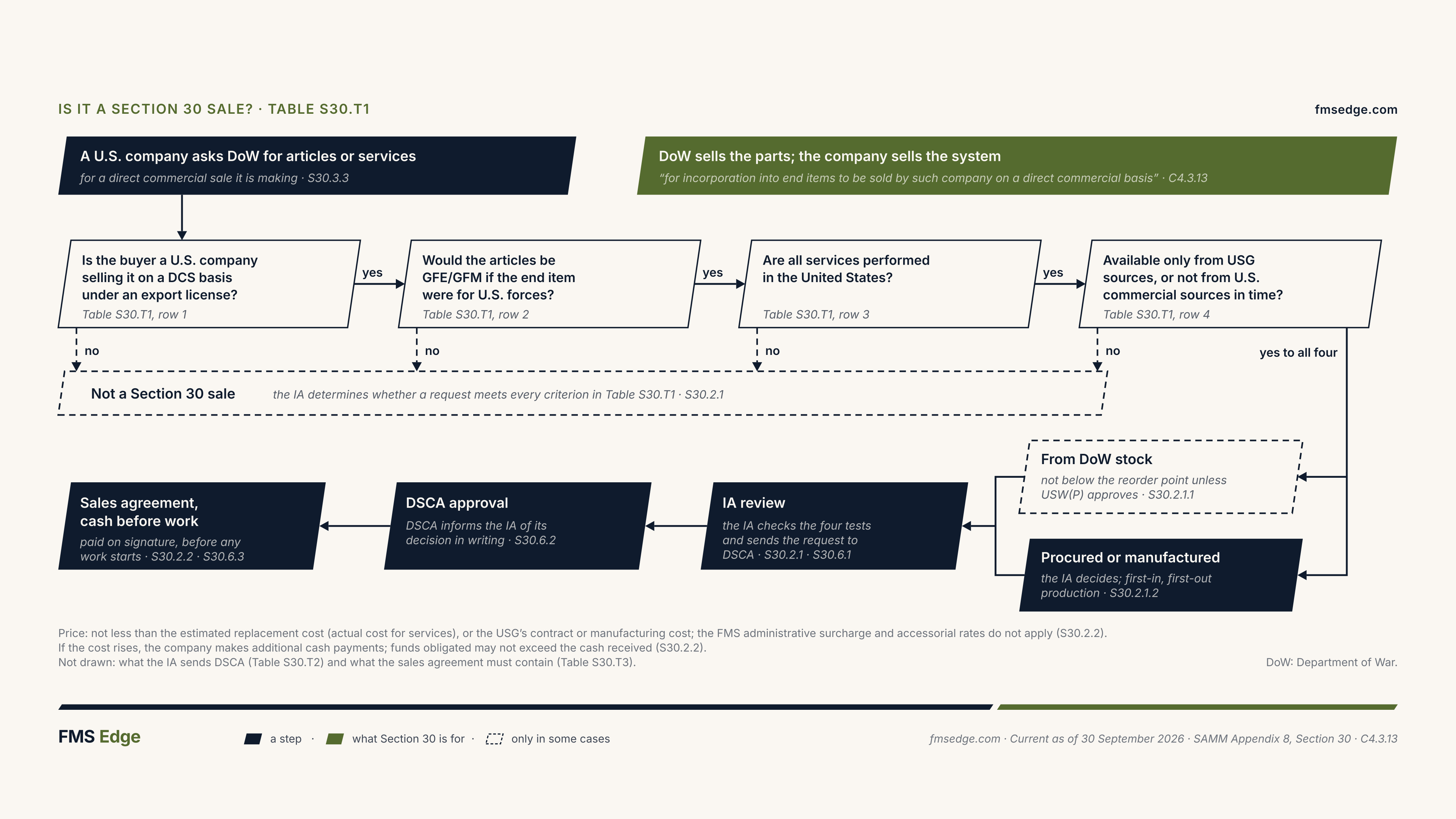
Defense articles and services the U.S. Government provides under this authority may be drawn from U.S. stocks, or procured or manufactured by the U.S. Government. They may be provided for sale, for incorporation into an , or for concurrent or follow-on support of that , within the limits that Table S30.T1 sets. Once the approves a Section 30 sale, the concludes and executes the sales agreement with the U.S. company that asked for it [SAMM ].
A sale is not authorized if it would take Department of War stocks below the , unless the Under Secretary of War for Policy, coordinating with the Under Secretary of War for Acquisition and Sustainment, approves it [SAMM ]. When a sale requires procurement, or manufacturing in government-owned facilities, the determines whether the sale shall be concluded. In setting production priorities, the considers existing requirements and schedules manufacture, allocation and delivery first in, first out, guided by DoDI 4140.01 and by the Force/Activity Designators that the Chairman of the Joint Chiefs of Staff assigns. Section C6.4.6 covers questions of priority among competing U.S. or foreign requirements [SAMM ].
The U.S. company sends the applicable a request for a Section 30 sale that meets the statutory requirements, explaining the request and its background. If the sale is approved, the company executes a Section 30 sales agreement with the [SAMM ]. 's Execution Policy and Analysis Directorate in the Office of Strategy, Plans, and Policy (SPP/EPA) staffs the 's request within and informs the of the decision. The executes the agreement with the company once has told it in writing that the proposed sale is approved [SAMM ].
The uses a unique sales agreement for the sale of defense articles and/or services to U.S. companies. Appendix 8, Table S30.T3, outlines the information included in the sales agreement [SAMM ]. To allow for planning and marketing, are authorized to provide cost and delivery data to authorized potential companies before a sales agreement is approved. Such data must be identified as estimates that do not bind the [SAMM ].
In general, Section 30 sales should be made on a negotiated contract basis. The price should be no less than the articles' estimated replacement cost (or the actual cost of services) or, where the U.S. Government procures or manufactures the items, no less than its contract or manufacturing cost. The that executes the sale shall make sure it recovers the full cost of doing so, including the pricing elements in 7000.14-R, Volume 11a, Chapter 1. The administrative surcharge and accessorial rates do not apply to Section 30 sales [SAMM ].
Sales shall be in cash, paid when U.S. Government and company representatives sign the sales agreement. Payment in U.S. dollars shall come before procurement, production action, delivery (in sales from stock) or performance of a service. Funds obligated for a reimbursable procurement, for producing articles internally or for providing services may not exceed the cash received from an authorized purchaser. The purchaser is required to make additional cash payments to cover any increase in the cost [SAMM ].
References
SAMM
- SAMM AP8.S30.2.1: Section 30 Sales Eligibility Requirements.
- SAMM AP8.S30.4.1: Planning Data.
- SAMM AP8.S30.T3: Section 30 Sales Agreement Requirements
- SAMM AP8.S30.1.1: Section 30 Sales Authority.
- SAMM AP8.S30.2.1.1: Section 30 Sales from Stock.
- SAMM AP8.S30.2.1.2: Section 30 Sales from Procurement or Manufacturing.
- SAMM AP8.S30.3.3: United States Company.
- SAMM AP8.S30.6.2: Approval.
- SAMM AP8.S30.2.2: Pricing for Section 30 Sales.
- SAMM AP8.S30.6.3: Section 30 Sales Format.
Related
Arms Export Control Act (AECA)
The basic U.S. law providing the authority and general rules for the conduct of Foreign Military Sales and commercial sales of defense articles, defense services, and training. The Arms Export Control Act (AECA) came into existence with the passage of the Foreign Military Sales Act (FMSA) of 1968. An amendment in the International Security Assistance and AECA of 1976 changed the name of FMSA to the AECA.
SAMM Glossary, as of 12 September 2026
Glossary entry →Open the manual’s entry → (opens in new tab)
End Item
A finished combination of end products, component parts or materials, assembled or completed and ready for its intended use, issue or deployment, such as an aircraft, a truck, a mobile generator or a rifle.
FMS Edge glossary, as of 10 October 2026
Glossary entry →Open the manual’s entry → (opens in new tab)
Defense Security Cooperation Agency (DSCA)
The Department of War agency that directs, administers and provides guidance to the Department's components and its representatives at U.S. missions for the execution of the security cooperation programs for which it is responsible [SAMM C1.3.2.2]. The agency also provides financial and technical assistance, arranges the transfer of defense materiel, training and services to international partners, and promotes military-to-military contacts.
FMS Edge glossary, as of 10 October 2026
Glossary entry →Open the manual’s entry → (opens in new tab)
Foreign Military Sales (FMS)
The part of U.S. security assistance, authorized by the Arms Export Control Act (AECA), in which eligible foreign governments and international organizations buy defense articles, services and training from the U.S. Government under formal government-to-government agreements.
The articles come either from Department of War stocks or from new procurement under contracts the Department manages [22 U.S.C. 2761, 22 U.S.C. 2762]. A sale is FMS whatever the source of the purchaser's financing.
FMS Edge glossary, as of 10 October 2026
Glossary entry →Open the manual’s entry → (opens in new tab)
Direct Commercial Sale (DCS)
A sale of defense articles or defense services made under a Department of State issued license by U.S. industry directly to a foreign buyer, and which is not administered by DoD through Foreign Military Sales procedures.
SAMM Glossary, as of 12 September 2026
Glossary entry →Open the manual’s entry → (opens in new tab)
SAMM: Security Assistance Management Manual
SAMM Acronyms, as of 12 September 2026
Glossary entry →Security Assistance Management Manual (SAMM) →
Government Furnished Equipment (GFE)
Items in the possession of, or acquired by the USG, and delivered to or otherwise made available to a contractor.
SAMM Glossary, as of 12 September 2026
Glossary entry →Open the manual’s entry → (opens in new tab)
Government Furnished Material (GFM)
USG property which may be incorporated into, or attached to an end item to be delivered under a contract or which may be consumed in the performance of a contract. It includes, but is not limited to, raw and processed material, parts, components, assemblies, small tools, and supplies.
SAMM Glossary, as of 12 September 2026
Glossary entry →Open the manual’s entry → (opens in new tab)
Implementing Agency (IA)
The military department or defense agency responsible for the execution of military assistance programs. With respect to FMS, the military department or defense agency assigned responsibility by the Defense Security Cooperation Agency to prepare an LOA and to implement an FMS case. The implementing agency is responsible for the overall management of the actions that will result in delivery of the materials or services set forth in the LOA that was accepted by a foreign country or international organization.
SAMM Glossary, as of 12 September 2026
Glossary entry →Open the manual’s entry → (opens in new tab)
Reorder Point
The point at which time a stock replenishment requisition is submitted to maintain the predetermined stock age objective.
SAMM Glossary, as of 12 September 2026
Glossary entry →Open the manual’s entry → (opens in new tab)
DSCA: Defense Security Cooperation Agency
SAMM Acronyms, as of 12 September 2026
Glossary entry →Defense Security Cooperation Agency (DSCA) →
Continental United States (CONUS)
U.S. territory, including the adjacent territorial waters, located within the North American continent between Canada and Mexico. Does not include Hawaii or Alaska.
SAMM Glossary, as of 12 September 2026
Glossary entry →Open the manual’s entry → (opens in new tab)
Defense Transportation System (DTS)
The part of the worldwide transportation infrastructure that supports Department of War transportation needs in peace and war, made up of military (organic) and commercial resources that are organic to the Department, under contract to it or controlled by it [SAMM C7.6.1].
It takes in organic and commercial aircraft and ships, commercial small-package services under Department contract, and U.S. military air and ocean terminals in and outside the United States.
FMS Edge glossary, as of 10 October 2026
Glossary entry →Open the manual’s entry → (opens in new tab)
Payment Schedule
List of dollar amounts and when they are due from the foreign customer. The payment schedule is included in the Letter of Offer and Acceptance (LOA) presented to the customer. After acceptance of the LOA, the payment schedule generally serves as the basis for billing to the customer. Changes in the estimated costs of an Foreign Military Sales case may require changes in the accompanying payment schedule.
SAMM Glossary, as of 12 September 2026
Glossary entry →Open the manual’s entry → (opens in new tab)
Contracting Officer
A person with the authority to enter into, administer, and/or terminate contracts and make related determinations and findings. The term includes certain authorized representatives of the Contracting Officer acting within the limits of their authority as delegated by the Contracting Officer. A Contracting Officer whose primary responsibility is to enter into contracts is called a procuring contracting officer. One whose primary responsibility is to administer contracts is called an administrative contracting officer. One whose primary responsibility is to terminate contracts and/or settle terminated contracts is called a "termination contracting officer." A single contracting officer may be responsible for duties in any or all of these areas.
SAMM Glossary, as of 12 September 2026
Glossary entry →Open the manual’s entry → (opens in new tab)
Military Interdepartmental Purchase Request (MIPR)
An order issued by one military service to another to procure services, supplies, or equipment for the requiring service. The MIPR (DD Form 448) may be accepted on a direct citation or reimbursable basis. It is an Economy Act (31 U.S.C. 1535) order subject to downward adjustment when the obligated appropriation is no longer valid for obligation.
SAMM Glossary, as of 12 September 2026
Glossary entry →Open the manual’s entry → (opens in new tab)
SAMM AP8.S30.1.1: Section 30 Sales Authority.
“Arms Export Control Act (AECA), Section 30 (22 U.S.C. 2770) authorizes the USG to sell defense articles and defense services to U.S. Companies in support of direct commercial sales pursuant to an export license or approval. Defense articles and defense services provided by the USG pursuant to this authorization may be sourced from U.S. stocks, procured by the USG, or …”
Security Assistance Management Manual, as of 30 September 2026
SAMM AP8.S30.2.1: Section 30 Sales Eligibility Requirements.
“The Implementing Agency (IA) determines whether the proposed sale meets all of the criteria for an Arms Export Control Act (AECA), Section 30 (22 U.S.C. 2770) request (see Table S30.T1.). Table S30.T1. Section 30 Sales Eligibility Requirements # Section 30 Sales Eligibility Requirements 1 The sale of a defense article or defense service is to a company incorporated in the …”
Security Assistance Management Manual, as of 30 September 2026
SAMM AP8.S30.2.1.1: Section 30 Sales from Stock.
“Sales are not authorized if they cause DoD stocks to drop below the reorder point unless approved by the Under Secretary of War for Policy (USW(P)) in coordination with the Under Secretary of War for Acquisition and Sustainment (USW(A&S)).”
Security Assistance Management Manual, as of 9 November 2026
SAMM AP8.S30.2.1.2: Section 30 Sales from Procurement or Manufacturing.
“The Implementing Agency (IA) determines if a sale shall be concluded when procurement or manufacturing in government-owned facilities is required. In determining production priorities, the IA considers existing requirements and schedules the manufacture, allocation, and delivery on a first-in first-out basis guided by Department of Defense Instruction (DoDI) 4140.01 “DoD Supply Chain Materiel Management Policy” and related assignments of Force/Activity …”
Security Assistance Management Manual, as of 30 September 2026
SAMM AP8.S30.3.3: United States Company.
“The U.S. Company submits a request to the applicable IA for a Section 30 sale that is in accordance with the statutory requirements. In the submission, the U.S. Company provides an explanation and background for the Section 30 ale request. If approved, the U.S. Company executes a Section 30 sales agreement with the IA”
Security Assistance Management Manual, as of 30 September 2026
SAMM AP8.S30.6.2: Approval.
“DSCA (SPP/EPA) staffs the IA request within DSCA and informs the IA of the decision. Once informed in writing that DSCA has approved a proposed sale, the IA executes the sale agreement with the U.S. Company.”
Security Assistance Management Manual, as of 30 September 2026
SAMM AP8.S30.6.3: Section 30 Sales Format.
“A unique sales agreement is used by the USG for the sale of defense articles and/or defense services to U.S. Companies under the authority of Arms Export Control Act (AECA), Section 30 (22 U.S.C. 2770). The sales agreement includes the information outlined in Table S30.T3. Table S30.T3. Section 30 Sales Agreement Requirements # General Provisions and/or Notes Required 1 The …”
Security Assistance Management Manual, as of 30 September 2026
SAMM AP8.S30.4.1: Planning Data.
“To allow planning and marketing, Implementing Agencies are authorized to provide cost and delivery data to authorized potential U.S. Company purchasers in advance of approval of a sales agreement. Such data must be identified as estimates that does not bind the USG to any agreements or present false impressions that sales will be made.”
Security Assistance Management Manual, as of 30 September 2026
SAMM AP8.S30.2.2: Pricing for Section 30 Sales.
“In general, sales of defense articles and defense services under Section 30 sales should be conducted under a negotiated contract basis (1) at not less than their estimated replacement cost (or actual cost in the case of services), or (2) at not less than their contract or manufacturing cost to the USG when procured or manufactured by the USG. The …”
Security Assistance Management Manual, as of 9 November 2026