
Guide
Can a country lease U.S. defense articles instead of buying them?
Yes, in limited cases. The U.S. normally sells defense articles through , but it may lease them when there are compelling foreign policy and national security reasons to lease rather than sell. The lessee pays the costs, including depreciation, and the U.S. can end the lease and take the articles back at any time.
A lease starts with the partner's Letter of Request to the Implementing Agency, which decides with DSCA whether a lease fits. A lease runs from one month to 60 months, plus the time needed for major refurbishment, and a lease of a year or longer is notified to Congress 30 calendar days in advance.
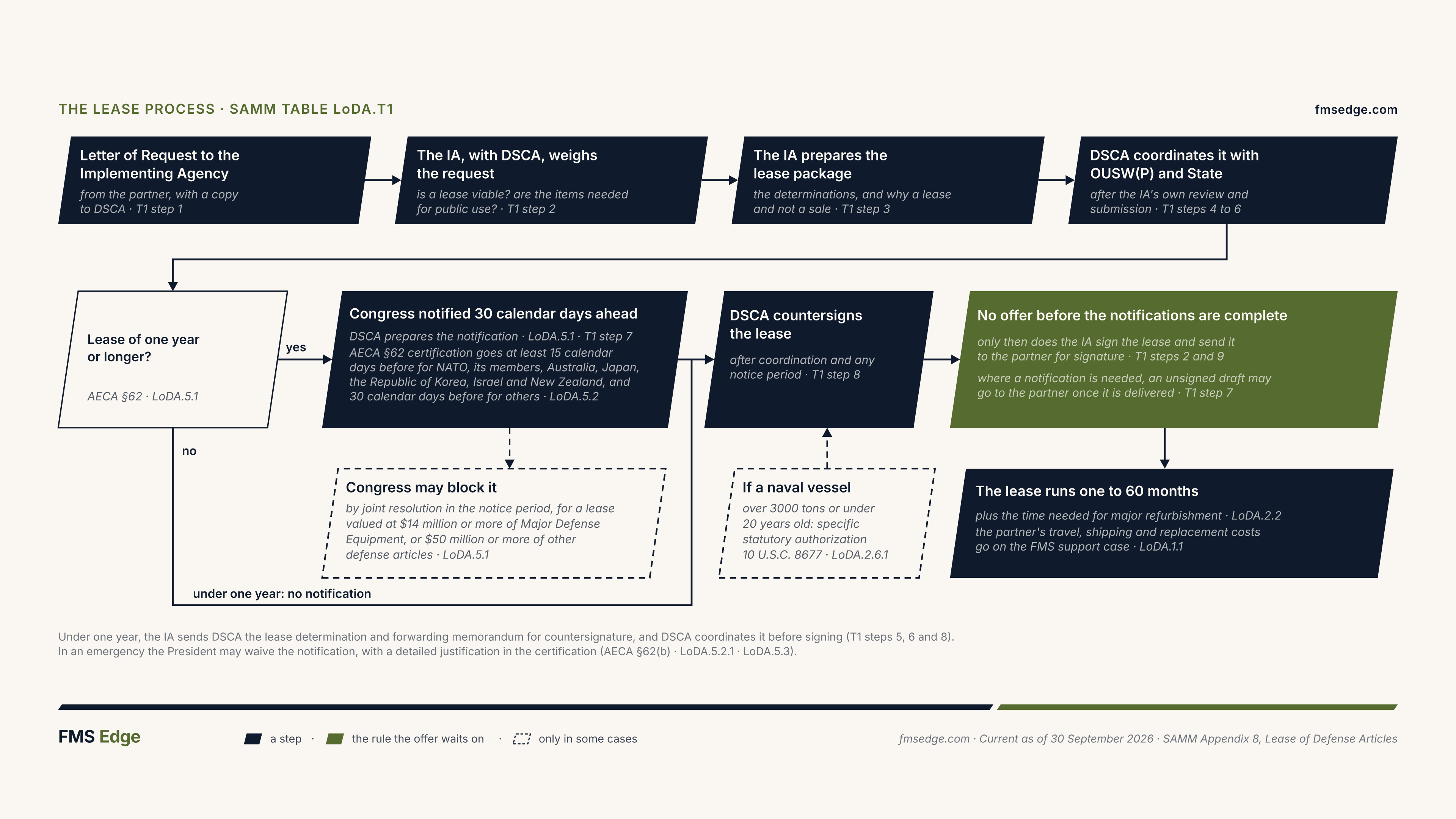
When does the U.S. lease defense articles instead of selling them?
The U.S. Government () leases a instead of selling it through only when there are compelling foreign policy and national security reasons to lease. The article must not be needed for public use during the lease, and its effect on the national technology and must be considered [SAMM ]. Under Section 61, , the President may lease Department of War (DoW) defense articles to eligible partners and international organizations. A lease may support , military exercises, communications or electronics interface projects, or an urgent foreign requirement [SAMM ].
Normally, the makes defense articles available to international partners by under the . However, there are instances where a lease, rather than sale, to eligible international partners is appropriate. Leases are authorized under the AECA, Section 61, when it is determined that there are compelling foreign policy and national security reasons for leasing rather than selling and the articles are not needed for use during the proposed lease period. In addition, impact of the lease on the national must be considered, including whether a lease reduces the opportunity of U.S. industry to sell new equipment to the leasing international partner []. For example, an international partner may desire to obtain a for a short period under a lease for testing purposes to assist it in determining whether to procure the article in quantity.
The President may lease defense articles in the stocks of the DoW to an eligible foreign country or international organization if the following occurs []:
- He determines there are compelling foreign policy and national security reasons for providing such articles on a lease basis rather than on a sales basis under the .
- He determines that the articles are not for the time needed for public use.
- He first considers the effects of the lease on the national technology and , particularly the extent, if any, to which the lease reduces the opportunities of entities in that base to sell new equipment to the country.
- The country or international organization has agreed to pay, in U.S. dollars, all costs incurred by the in leasing such articles. These include depreciation while leased, restoration or replacement if the articles are damaged, and, if they are lost or destroyed, their replacement cost or actual value, less any depreciation.
Defense articles in the stocks of the DoW may be leased or loaned to a foreign country or international organization only under the authority of Chapter 6, , or Part II, Chapter 2, Foreign Assistance Act (). They may not be leased to a foreign country or international organization under the authority of 10 U.S.C. 2667 [].
In , a lease is an agreement that temporarily transfers the right to possess and use one or more non-excess defense articles to a foreign government or international organization, under Section 61, . The lessee agrees to pay back, in U.S. dollars, every cost the incurs in leasing them, and to maintain, protect, repair or restore the articles.
Who approves a lease?
The Director of the approves a lease, under authority the President has delegated through the Secretary of War [SAMM ]. coordinates the lease package with the Department of State and with OUSW(P), the Office of the Under Secretary of War for Policy. Once coordination and any required congressional notification period are complete, the Director signs the lease determination [SAMM ].
The manual also states that the President's authority to decide on a lease is delegated to the Department of State, as it is for , and that then provides the congressional notifications [SAMM ]. The Department of Commerce reviews a proposed lease for its effect on the national technology and [SAMM ].
DoW components must obtain concurrence before indicating to an international partner or international organization that a lease is being favorably considered or is an available option [SAMM ].
How long can a lease run?
Leases may be written for a maximum of 60 months with an additional specified period of time required to complete major refurbishment work prior to delivery. The shortest lease period is one month and the longest lease period is 60 months [SAMM ]. Leases of one year or more require congressional notification in accordance with the AECA, Section 62(a) (22 U.S.C. 2796a) [SAMM ]. Leases shall provide that, at any time during the lease period, the may terminate the lease and require the immediate return of the . Leases of less than 60 months may be extended via an amendment, but the total period under a specific lease may not exceed 60 months plus the time needed for refurbishment [SAMM ]. A single lease can cover several items with different lease periods.
Lease amendments may be used to extend or change existing leases [SAMM ]. The confirms that payment schedules are updated for any extension, delivery schedule change or other amendment that changes the lease value or schedule of payments [SAMM ]. Each amendment includes the original lease designator [SAMM ]. If a lease for less than one year is amended so that the total period of the original lease and the amendment equals or exceeds one year, Congress must be notified of the amendment before it can be offered [SAMM , ]. An amendment goes through the same staffing as the original lease.
Each lease agreement shall be for a fixed duration, not to exceed five years, and shall provide that, at any time during the duration of the lease, the President may terminate the lease and require the immediate return of the leased articles [SAMM , ]. An extension is permitted, but Congress must be given advance notification of an extension that makes the lease one year or longer, and of a renewal for a period of one year or longer [SAMM , ] [].
What does the lessee pay?
The lessee must agree to pay in U.S. dollars all costs incurred by the in leasing articles, including reimbursement for depreciation (rent) of articles while leased. The rental payment is calculated in accordance with 7000.14-R, Volume 15, Chapter 7. Rental payments do not include an administrative charge [SAMM ]. The requirement to pay all lease costs does not apply to leases for purposes of cooperative research or development, military exercises, or communications or electronics interface projects [SAMM ]. Depreciation may be waived where the leased has passed 75 percent of its service life [SAMM ].
The international partner must agree to pay the costs of restoration or replacement if the articles are lost, damaged, or destroyed while leased. In this case, the international partner is charged the replacement cost (less any depreciation) if the U.S. intends to replace the articles or the actual article value (less any depreciation) if the U.S. does not intend to replace the articles. These charges may be recouped through an amendment or modification of the support case listed in the lease, or through a separate [SAMM ].
The cost reimbursement requirements do not apply to leases entered into for purposes of cooperative research or development, military exercises, communications, or electronics interface projects [SAMM ].
With a Presidential national security interest determination, the requirement for reimbursement of depreciation of any leased article that has passed three-quarters of its normal service life can also be waived []. This waiver authority is delegated to the Director [SAMM ].
Replacement cost of any leased item lost or destroyed would be either of the following [SAMM ]:
- The replacement cost, adjusted for the depreciated value of the item, if the intends to replace it
- The actual value of the item (the depreciated value of its most recent procurement cost) if the does not intend to replace it []
Schedule A of each lease identifies the replacement cost of each leased item and the schedule of rental payments due to the . The sets a quarterly , compatible with the billing cycle. Where the quarterly cycle would not bring payment in before the lease takes effect, an is required so that payment arrives ahead of the month in which a rental charge is incurred. The lessee, whether a partner or an international organization, is billed on this schedule, on a separate DD Form 645A that comes with the partner's quarterly billing statement. Under the Treasury Financial Manual, Supplement to Volume 1, the Defense Finance and Accounting Service () deposits lease rental receipts into Miscellaneous Receipts Account 3041 ( Recoveries, DoW Lease Costs) [SAMM ].
When must Congress be notified of a lease?
Congress must be given advance notification of any lease for a period of one year or longer, and provides the notification. The period is 30 calendar days. For such a lease, Congress may adopt a prohibiting it during the notification period when its value reaches $14 million for or $50 million for other defense articles [SAMM ].
The congressional advance notification period for leases to the North Atlantic Treaty Organization (), members, Japan, Australia, Republic of Korea, Israel, and New Zealand is 15 calendar days [SAMM ] []. Both periods can be waived by the President in the event of an emergency [SAMM ] [].
The certification required by Section 62(a), , goes to Congress. The President shall transmit it to the Speaker of the House of Representatives, the House Committee on Foreign Affairs, and the chairmen of the Senate Committees on Foreign Relations and on Armed Services []. For an agreement with any other organization or country, the certification shall be transmitted not less than 30 calendar days before the agreement is entered into or renewed [].
How is a lease closed?
The closes a lease in the Defense Management System (). It enters the delivery and equipment return dates and follows up with the Defense Finance and Accounting Service - Indianapolis () on financial closure. reconciles the financial information, working with the Country Finance Director (), and closes the lease in the . The closure procedures for a apply to a lease as well [SAMM ].
Lease closure procedures shall begin at least two quarters before the lease expires or is terminated. generates Management Flags for the lease Case Manager before the expiration date and after it, unless the lease has been closed [SAMM ]. When the items return to custody, the posts the Actual Return Date for each Lease Line in . Entering the Actual Return Dates is the 's responsibility, both in the Lease Line window and, once every line has been returned, in the Lease Detail window. Once all the required data has been entered, the must tell by email to its closure mailbox that the Lease Material Returned Milestone (LSERET) is now posted in . will then reconcile the financial information and, provided all rental payments and related costs have been collected, issue the closure certificate and close the lease in [SAMM ].
Loans for cooperative research
Under the AECA, section 65, the DoW may lend materiel, supplies, and equipment to and major non- allies for research and development purposes []. Loans that support cooperative Research, Development, Test, and Evaluation () programs strengthen the security of the United States and its allies by promoting standardization, interchangeability, and interoperability of allied defense equipment.
References
SAMM
- SAMM AP8.LoDA.2.6: What Can Be Leased.
- SAMM AP8.LoDA.1.1
- SAMM AP8.LoDA.T1: Lease Process
- SAMM AP8.LoDA.3.6: Department of Commerce.
- SAMM AP8.LoDA.2.2: Lease Duration.
- SAMM AP8.LoDA.2.2.2: Lease Identification.
- SAMM AP8.LoDA.5.2
- SAMM AP8.LoDA.2.3.1: Rental Payment.
- SAMM AP8.LoDA.2.3.2.1
- SAMM AP8.LoDA.2.3.2.2
- SAMM AP8.LoDA.2.3.3: Replacement of Lost or Damaged Items.
- SAMM AP8.LoDA.5.3: Waiver; Determination of Emergency.
- SAMM C16.3.19.1.1
- SAMM C16.3.19.1.2
- SAMM AP8.LoDA.2.3.4: Payment Schedules.
- SAMM AP8.LoDA.5.1
- SAMM AP8.LoDA.5.4: Transmission of Certification.
Public authorities
- AECA §61: Arms Export Control Act of 1976, as amended, §61 (22 U.S.C. §2796), Leasing authority
- AECA §62: Arms Export Control Act of 1976, as amended, §62 (22 U.S.C. §2796a), Reports to Congress
- AECA §65: Arms Export Control Act of 1976, as amended, §65 (22 U.S.C. §2796d), Loan of materials, supplies, and equipment for research and development purposes
Facts referenced
- Maximum lease period for defense articles, not counting the time needed for major refurbishment (AECA section 61): 60 months (as of 30 September 2026; SAMM AP8.LoDA.2.2)
- Minimum lease period for defense articles (AECA section 61), in months: one (as of 30 September 2026; SAMM AP8.LoDA.2.2)
- Share of its service life a leased defense article must have passed before the depreciation-reimbursement waiver can be requested (the IA's certifying letter): 75 percent (as of 30 September 2026; SAMM AP8.LoDA.2.3.2.2)
- Advance congressional notification for a lease of defense articles of one year or longer: 30 calendar days (as of 30 September 2026; SAMM AP8.LoDA.5.1)
- Value of Major Defense Equipment at or above which Congress, within the 30-calendar-day notice period, may adopt a joint resolution prohibiting a lease of defense articles of one year or longer: $14 million (as of 30 September 2026; SAMM AP8.LoDA.5.1)
- Value of other defense articles at or above which Congress, within the 30-calendar-day notice period, may adopt a joint resolution prohibiting a lease of one year or longer: $50 million (as of 30 September 2026; SAMM AP8.LoDA.5.1)
- Minimum AECA section 62 certification lead time for a lease of defense articles to NATO, its members, Australia, Japan, the Republic of Korea, Israel and New Zealand: 15 calendar days (as of 30 September 2026; SAMM AP8.LoDA.5.2)
- Minimum AECA section 62 certification lead time for a lease of defense articles to all other partners or organizations: 30 calendar days (as of 30 September 2026; SAMM AP8.LoDA.5.2)
- Minimum lead time for starting lease closure procedures before a lease expires or is terminated: two quarters (as of 11 September 2026; SAMM C16.3.19.1.1)
Related
Foreign Military Sales (FMS)
The part of U.S. security assistance, authorized by the Arms Export Control Act (AECA), in which eligible foreign governments and international organizations buy defense articles, services and training from the U.S. Government under formal government-to-government agreements.
The articles come either from Department of War stocks or from new procurement under contracts the Department manages [22 U.S.C. 2761, 22 U.S.C. 2762]. A sale is FMS whatever the source of the purchaser's financing.
FMS Edge glossary, as of 10 October 2026
Glossary entry →Open the manual’s entry → (opens in new tab)
Defense Article (Foreign Assistance Act; Arms Export Control Act, not including commercial sales subject to the International Traffic in Arms Regulation)
Any weapon, weapon system, munition, aircraft, vessel or other implement of war, together with the property, equipment, tooling, components and parts used to furnish military assistance or sales or to make, maintain or use such items; the International Traffic in Arms Regulations (ITAR) define the term separately for commercial exports.
Section 47 of the Arms Export Control Act (AECA) defines the term, and the U.S. Munitions List designates the specific items that fall within it [SAMM C4.4] [22 U.S.C. 2794].
FMS Edge glossary, as of 10 October 2026
Glossary entry →Open the manual’s entry → (opens in new tab)
Industrial Base
The part of a national economy that manufactures and maintains goods, chiefly through factories, maintenance facilities, processing plants and laboratories, whether privately or government owned. For U.S. defense it is the public facilities, academic institutions and commercial companies that research, develop, produce, deliver and maintain weapon systems and their parts for the U.S. military, together with closely connected capacity in Canada.
FMS Edge glossary, as of 10 October 2026
Glossary entry →Open the manual’s entry → (opens in new tab)
Arms Export Control Act (AECA)
The basic U.S. law providing the authority and general rules for the conduct of Foreign Military Sales and commercial sales of defense articles, defense services, and training. The Arms Export Control Act (AECA) came into existence with the passage of the Foreign Military Sales Act (FMSA) of 1968. An amendment in the International Security Assistance and AECA of 1976 changed the name of FMSA to the AECA.
SAMM Glossary, as of 12 September 2026
Glossary entry →Open the manual’s entry → (opens in new tab)
Cooperative Research and Development
A project in which the United States and one or more other countries or organizations jointly carry out research and development on new conventional defense equipment and munitions, or modify existing equipment to meet U.S. military requirements. The partners work under a memorandum of understanding or another formal agreement. Governments use it to make better use of their combined research and development resources, through technical data exchanges and co-development of new systems.
FMS Edge glossary, as of 10 October 2026
Glossary entry →Open the manual’s entry → (opens in new tab)
FMS: Foreign Military Sale
SAMM Acronyms, as of 12 September 2026
AECA: Arms Export Control Act
SAMM Acronyms, as of 12 September 2026
Security Assistance (SA)
A group of programs authorized by federal statutes by which the United States provides defense articles, military training, and other defense-related services by grant, lease, loan, credit, or cash sales in furtherance of national policies and objectives, and those that are funded and authorized through the Department of State to be administered by Department of Defense/Defense Security Cooperation Agency, which are considered part of security cooperation.
SAMM Glossary, as of 12 September 2026
Glossary entry →Open the manual’s entry → (opens in new tab)
Defense Security Cooperation Agency (DSCA)
The Department of War agency that directs, administers and provides guidance to the Department's components and its representatives at U.S. missions for the execution of the security cooperation programs for which it is responsible [SAMM C1.3.2.2]. The agency also provides financial and technical assistance, arranges the transfer of defense materiel, training and services to international partners, and promotes military-to-military contacts.
FMS Edge glossary, as of 10 October 2026
Glossary entry →Open the manual’s entry → (opens in new tab)
DSCA: Defense Security Cooperation Agency
SAMM Acronyms, as of 12 September 2026
Glossary entry →Defense Security Cooperation Agency (DSCA) →
Implementing Agency (IA)
The military department or defense agency responsible for the execution of military assistance programs. With respect to FMS, the military department or defense agency assigned responsibility by the Defense Security Cooperation Agency to prepare an LOA and to implement an FMS case. The implementing agency is responsible for the overall management of the actions that will result in delivery of the materials or services set forth in the LOA that was accepted by a foreign country or international organization.
SAMM Glossary, as of 12 September 2026
Glossary entry →Open the manual’s entry → (opens in new tab)
Letter of Offer and Acceptance (LOA)
The legal instrument that lists the defense articles and services, including training, that the U.S. Government transfers to a foreign country or international organization, with their estimated costs and the terms and conditions. The benefitting partner does not sign a Building Partner Capacity (BPC) LOA.
The Letter of Offer and Acceptance (LOA) is the instrument the U.S. Government uses to sell under the Arms Export Control Act (AECA); signed LOAs and their later Amendments and Modifications are also called Foreign Military Sales (FMS) cases [SAMM C5.6.1].
FMS Edge glossary, as of 10 October 2026
Glossary entry →Open the manual’s entry → (opens in new tab)
Payment Schedule
List of dollar amounts and when they are due from the foreign customer. The payment schedule is included in the Letter of Offer and Acceptance (LOA) presented to the customer. After acceptance of the LOA, the payment schedule generally serves as the basis for billing to the customer. Changes in the estimated costs of an Foreign Military Sales case may require changes in the accompanying payment schedule.
SAMM Glossary, as of 12 September 2026
Glossary entry →Open the manual’s entry → (opens in new tab)
Initial Deposit
The payment a Foreign Military Sales (FMS) purchaser sends when it accepts a Letter of Offer and Acceptance (LOA), as full or partial payment for the articles, services or training it has agreed to buy.
Each LOA includes an initial deposit that covers the nonrecurring cost payment and the outlays or deliveries expected before the purchaser's first quarterly payment arrives [SAMM C9.9.1.5.1].
FMS Edge glossary, as of 10 October 2026
Glossary entry →Open the manual’s entry → (opens in new tab)
Joint Resolution
A legislative resolution, designated H J Res (House) or S J Res (Senate) which requires the approval of both houses and the signature of the President, just as a bill does, and which has the force of law if approved. There is no practical difference between a bill and a joint resolution. A joint resolution generally is used to deal with a limited matter such as a single appropriation. Congressional rejection of a proposed arms transfer, lease, third country transfer, or a proposed international cooperative project takes the form of a joint resolution of disapproval.
SAMM Glossary, as of 12 September 2026
Glossary entry →Open the manual’s entry → (opens in new tab)
Major Defense Equipment (MDE)
Any item of Significant Military Equipment on the U.S. Munitions List having a nonrecurring research and development cost of more than $50 million or a total production cost of more than $200 million. Also defined in section 47 (6), Arms Export Control Act.
SAMM Glossary, as of 12 September 2026
Glossary entry →Open the manual’s entry → (opens in new tab)
DSAMS: Defense Security Assistance Management System
SAMM Acronyms, as of 12 September 2026
Glossary entry →Defense Security Assistance Management Systems (DSAMS) →
DFAS-IN: Defense Finance and Accounting Service - Indianapolis
SAMM Acronyms, as of 12 September 2026
Defense Integrated Financial System (DIFS)
A financial system providing DoD-level financial management functions for the security assistance (SA) program. This includes centralized Foreign Military Sales (FMS) trust fund accounting, foreign customer billing, and financial management reporting. DIFS consolidates FMS data from the Army, Navy, Air Force, and other implementing agencies, and provides efficient accountability for oversight of the financial and program management aspects of SA.
SAMM Glossary, as of 12 September 2026
Glossary entry →Open the manual’s entry → (opens in new tab)
DIFS: Defense Integrated Financial System
SAMM Acronyms, as of 12 September 2026
Glossary entry →Defense Integrated Financial System (DIFS) →
RDT&E: Research, Development, Test, and Evaluation
SAMM Acronyms, as of 12 September 2026
SAMM AP8.LoDA.2.6: What Can Be Leased.
“The President may lease defense articles from DoW stock to eligible partners or international organizations if there are compelling foreign policy and national security reasons for providing such articles on a lease basis rather than as a sale; the articles are not needed for the time for public use; and the effects of the lease on the national technology and …”
Security Assistance Management Manual, as of 9 November 2026
SAMM AP8.LoDA.1.1
“Under Arms Export Control Act (AECA), Section 61 (22 U.S.C. 2796), the President may lease DoW defense articles to eligible partners or international organizations for a period not to exceed 5 years plus a specified period of time required to complete major refurbishment work prior to delivery. The President has delegated this authority to the Secretary of War (SECWAR) who …”
Security Assistance Management Manual, as of 9 November 2026
Arms Export Control Act of 1976, as amended, §61 (22 U.S.C. §2796), Leasing authority
AECA §61 · Statute
SAMM AP8.LoDA.T1: Lease Process
“Table LoDA.T1. Lease Process Step Action 1 Purchaser Request for Lease An eligible partner or international organization identifies a requirement and submits a Letter of Request (LOR) to the respective Implementing Agency (IA) with a courtesy copy to DSCA (Office of International Operations (IOPS)). 2 Responses to Lease Requests The IA determines whether a lease is a viable option and …”
Security Assistance Management Manual, as of 9 November 2026
SAMM AP8.LoDA.5.1
“Congress must be given a 30-calendar day advance notification for any lease for a period of one year or longer. Like Foreign Military Sales (FMS), the Presidential decision authority to lease is delegated to the Department of State (State), with DSCA providing the subsequent Congressional Notifications (CNs). Further, if the lease is for one year or longer, and is valued …”
Security Assistance Management Manual, as of 30 September 2026
SAMM AP8.LoDA.3.6: Department of Commerce.
“The Department of Commerce (DOC) Office of Strategic Industries and Economic Security reviews proposed leases to determine if the proposed lease will have adverse impact on the national technology and industrial base or will reduce the opportunities of entities in the national technology and industrial base to sell new or used equipment.”
Security Assistance Management Manual, as of 30 September 2026
SAMM AP8.LoDA.2.2: Lease Duration.
“The minimum lease period is one month. The maximum lease period is 60 months plus the specified period of time required to complete major refurbishment of the leased articles prior to delivery. The draft lease includes the initiation and finish dates and the proposed timeframe the lease should start after staffing and Congressional Notifications (CNs) are complete. The lease must …”
Security Assistance Management Manual, as of 30 September 2026
SAMM AP8.LoDA.2.3.4: Payment Schedules.
“Schedule A of each lease identifies the replacement cost(s) of the item(s) being leased and the schedule for rental payment due to the USG. The IA establishes a payment schedule on a quarterly billing cycle compatible with the FMS billing cycle. If the quarterly cycle does not provide for payment prior to the effective date of the lease, an initial …”
Security Assistance Management Manual, as of 9 November 2026
SAMM AP8.LoDA.2.2.2: Lease Identification.
“The IA assigns a unique designator to each lease in DSAMS. The lease designator is composed of the FMS Customer Code, the IA code, and a 3-position code assigned by the IA. The lease designator is included on each lease page, all schedules, appendices, and accompanying documents included. FMS cases associated with leases must reference the lease designator(s), additionally, leases …”
Security Assistance Management Manual, as of 30 September 2026
SAMM AP8.LoDA.5.2
“For entering into or renewing a lease agreement for a period of one year or longer, the Arms Export Control Act (AECA), Section 62(a) (22 U.S.C. 2796(a)) provides requirements for the President. The President provides written certification to the Speaker of the House of Representatives, the Chairman of the Committee on Foreign Relations of the House, the Chairman of the …”
Security Assistance Management Manual, as of 30 September 2026
Arms Export Control Act of 1976, as amended, §62 (22 U.S.C. §2796a), Reports to Congress
AECA §62 · Statute
SAMM AP8.LoDA.2.3.1: Rental Payment.
“The lessee must agree to pay in U.S. dollars all costs incurred by the USG for the leased articles, including reimbursement for depreciation of articles during the lease period. The rental payment is calculated in accordance with Department of War Financial Management Regulation (DoW FMR), DoW 7000.14-R, Volume 15, Chapter 7. Rental payments do not include an administrative charge.”
Security Assistance Management Manual, as of 9 November 2026
SAMM AP8.LoDA.2.3.2.1
“Leases for the purposes of cooperative research or development, military exercises, or communications or electronics interface projects do not require reimbursement for depreciation and other costs incurred by the USG.”
Security Assistance Management Manual, as of 30 September 2026
SAMM AP8.LoDA.2.3.2.2
“The President may waive reimbursement of depreciation for any defense article(s) that has passed three-quarters of its normal service life if it is in the national security interests of the United States. This waiver authority is delegated to the DSCA Director in accordance with the provisions of DoD Directive (DoDD) 5105.65. When requesting this waiver, the IA must provide DSCA …”
Security Assistance Management Manual, as of 30 September 2026
SAMM AP8.LoDA.2.3.3: Replacement of Lost or Damaged Items.
“The lessee must agree to pay the costs of restoration or replacement if the articles are lost, damaged, or destroyed while leased. If items are lost or destroyed, the partner is charged the replacement cost. These costs are adjusted for either 1) the depreciated value of the destroyed item if the United States intends to replace the articles, or 2) …”
Security Assistance Management Manual, as of 30 September 2026
SAMM AP8.LoDA.5.4: Transmission of Certification.
“The certification required by subsection (a) of AECA, Section 62(a) (22 U.S.C. 2796(a)) must be transmitted to the partner 15 calendar days before the agreement is entered into or renewed if the agreement is with NATO, any member partner of that Organization, or Australia, Japan, the Republic of Korea, Israel, or New Zealand. For an agreement with any other organization …”
Security Assistance Management Manual, as of 30 September 2026
SAMM AP8.LoDA.5.3: Waiver; Determination of Emergency.
“The President may waive the requirements of AECA, Section 62(a) (22 U.S.C. 2796(a)) (and in the case of an agreement described in section 2796b, may waive the provisions of that section) if the certification statement confirms an emergency in the national security interests of the United States exists and requires the immediate initiation of a lease. If the President states …”
Security Assistance Management Manual, as of 30 September 2026
SAMM C16.3.19.1.1
“Lease closure procedures shall begin at least two quarters prior to the expiration or termination of the lease. Management Flags are generated by DSAMS to the Lease CM prior to the lease expiration date and post-expiration unless the Lease has been closed.”
Security Assistance Management Manual, as of 11 September 2026
SAMM C16.3.19.1.2
“Upon return of the items to USG custody, the IA posts the item Actual Return Date for each Lease Line in DSAMS. The IA is responsible for entering the Actual Return Dates to both the Lease Line window and the Lease Detail window (when all lines have been returned). When all required data has been entered, the IA must notify …”
Security Assistance Management Manual, as of 11 September 2026
Arms Export Control Act of 1976, as amended, §65 (22 U.S.C. §2796d), Loan of materials, supplies, and equipment for research and development purposes
AECA §65 · Statute