
Guide
What is a security assistance survey team?
A survey team is a U.S. Government team sent to a partner country, usually at its request, to review its military capabilities and recommend how to meet objectives; a survey implies no U.S. commitment to provide military equipment, and surveys are reported to Congress. An Expeditionary Requirements Generation Team, organized by the to help define requirements, is a related but different team. A is the survey an holds for a sale to plan its logistics support.
A security assistance survey team starts with a country's request or a U.S. proposal, and the Secretary of State decides whether to send one. In country it serves under the Ambassador and promises nothing, and it sends a draft report within 30 days.
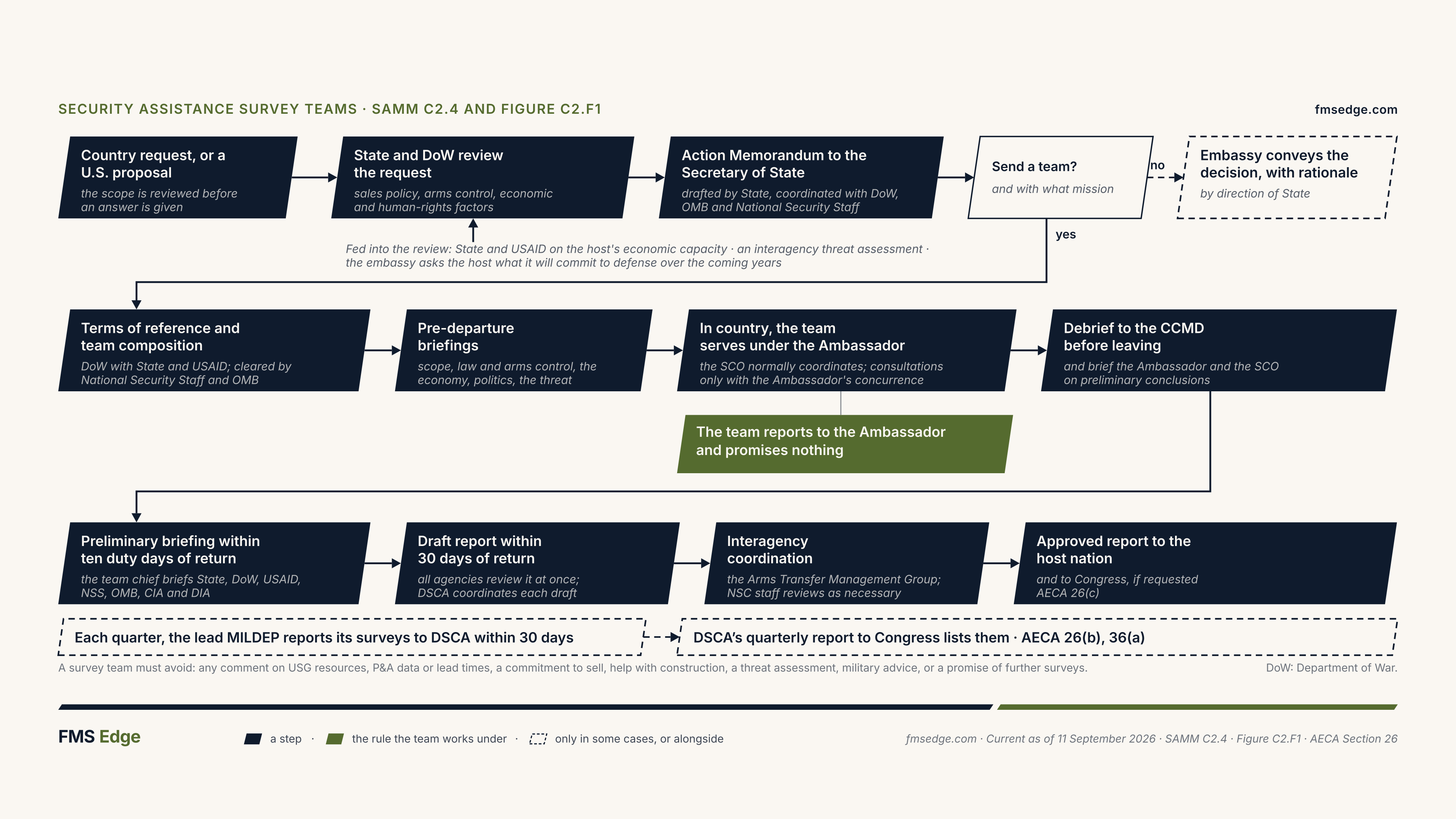
What does a security assistance survey team do?
surveys include any survey or study conducted in a foreign country by U.S. Government () personnel for the purpose of assessing the needs of that country for . Defense requirement surveys, site surveys, general surveys or studies, and engineering assessment surveys all represent various types of surveys. It is the policy of the U.S. that the results of surveys do not imply a commitment by the U.S. to provide any military equipment to any foreign country. Recommendations in such surveys should be consistent with the arms export control policy provided in the . As part of the quarterly report required by Section 36(a), , the President shall include information on all such surveys authorized during the preceding calendar quarter [, , ].
A similar but not a replacement program titled Expeditionary Requirements Generation Team () was established by policy 11-18, 31 March 2011. deploy to augment staffs and Organizations () with () expertise in support of planning and execution of capability-building efforts [SAMM ].
When a country asks for one, a Survey Team is organized to survey the country's military capabilities in country and to recommend how to meet objectives. Such teams are generally funded by a , and a team can combine commercial contractors, representatives of the host nation and personnel. A comprehensive survey of the country's military capabilities may be requested to set a baseline for a new program, and surveys may also be held within an ongoing program to address specific needs. Figure C2.F1 gives the survey teams, their roles and their reporting requirements. Logistics conferences for program definition are excluded from those requirements [SAMM ].
What is an Expeditionary Requirements Generation Team?
An Expeditionary Requirements Generation Team is a team that organizes and deploys to add expertise to staffs and as they plan and carry out capability-building efforts. help and turn a partner nation's capability needs into well-defined, specific requirements, which are then used to prepare high-quality partner Letters of Request () and the Letters of Offer and Acceptance () that follow [SAMM ].
may be formed to meet a wide range of and needs, but they focus mainly on helping define requirements and develop comprehensive solutions. An 's size and makeup depend on the situation and objectives the describes in its request for support. A team can be built around a country or a region, and it may deploy to a partner nation or to the headquarters, or provide "virtual" augmentation from Washington, D.C., using the full range of information and communications technologies [SAMM ].
What is a site survey?
Site surveys are associated with sales. They are the foundation of logistics support provided to the international partner. Site surveys are typically held in the international partner’s country with representatives from the , representatives of the manufacturer, and the international partner. The structure of the team may be a few people for several days for small, relatively simple weapon systems, to a large contingent of technical experts and logistics managers meeting with the international partner in country for several weeks.
The purpose of the is to tailor the maintenance and supply support strategy for the to the unique requirements of the international partner. During the , the international partner should become acquainted with the ’s acquisition and delivery process, the maintenance support plan, and the initial spare parts and support equipment allowances. The team will confirm the international partner’s operational and support plan, verify the international partner’s in-country logistics resources and requirements, prepare a plan for the delivery of materiel and services, and prepare a proposal for follow-on logistics support.
References
Public authorities
- AECA §26: Arms Export Control Act of 1976, as amended, §26 (22 U.S.C. §2766)
- AECA §36(b): Arms Export Control Act of 1976, as amended, §36(b) (22 U.S.C. §2776(b))
Related
Security Assistance (SA)
A group of programs authorized by federal statutes by which the United States provides defense articles, military training, and other defense-related services by grant, lease, loan, credit, or cash sales in furtherance of national policies and objectives, and those that are funded and authorized through the Department of State to be administered by Department of Defense/Defense Security Cooperation Agency, which are considered part of security cooperation.
SAMM Glossary, as of 12 September 2026
Glossary entry →Open the manual’s entry → (opens in new tab)
Security Cooperation
Activities by which the Department of War encourages and enables international partners to cooperate with the United States toward strategic objectives, spanning every interaction with foreign defense and security establishments and every security assistance program the Department administers.
Under chapter 16 of Title 10, their purposes are to develop allied and friendly security capabilities for self-defense and multinational operations, to give U.S. forces peacetime and contingency access, and to build relationships promoting specific U.S. security interests [10 U.S.C. 301(7)].
FMS Edge glossary, as of 10 October 2026
Glossary entry →Open the manual’s entry → (opens in new tab)
Defense Security Cooperation Agency (DSCA)
The Department of War agency that directs, administers and provides guidance to the Department's components and its representatives at U.S. missions for the execution of the security cooperation programs for which it is responsible [SAMM C1.3.2.2]. The agency also provides financial and technical assistance, arranges the transfer of defense materiel, training and services to international partners, and promotes military-to-military contacts.
FMS Edge glossary, as of 10 October 2026
Glossary entry →Open the manual’s entry → (opens in new tab)
Site Survey
A team of U.S. personnel who assess the Foreign Military Sales customer's logistics capabilities and shortfalls to determine the optimum type and quantity of logistics support to be included in the Total Package Approach.
SAMM Glossary, as of 12 September 2026
Glossary entry →Open the manual’s entry → (opens in new tab)
Implementing Agency (IA)
The military department or defense agency responsible for the execution of military assistance programs. With respect to FMS, the military department or defense agency assigned responsibility by the Defense Security Cooperation Agency to prepare an LOA and to implement an FMS case. The implementing agency is responsible for the overall management of the actions that will result in delivery of the materials or services set forth in the LOA that was accepted by a foreign country or international organization.
SAMM Glossary, as of 12 September 2026
Glossary entry →Open the manual’s entry → (opens in new tab)
Weapon System
A combination of one or more weapons with all related equipment, materials, services, personnel, and means of delivery and deployment (if applicable) required for self-sufficiency.
SAMM Glossary, as of 12 September 2026
Glossary entry →Open the manual’s entry → (opens in new tab)
Arms Export Control Act (AECA)
The basic U.S. law providing the authority and general rules for the conduct of Foreign Military Sales and commercial sales of defense articles, defense services, and training. The Arms Export Control Act (AECA) came into existence with the passage of the Foreign Military Sales Act (FMSA) of 1968. An amendment in the International Security Assistance and AECA of 1976 changed the name of FMSA to the AECA.
SAMM Glossary, as of 12 September 2026
Glossary entry →Open the manual’s entry → (opens in new tab)
AECA: Arms Export Control Act
SAMM Acronyms, as of 12 September 2026
Combatant Command (CCMD)
A unified or specified command with a broad continuing mission under a single commander established and so designated by the President, through the Secretary of Defense and with the advice and assistance of the Chairman of the Joint Chiefs of Staff. Also called CCMD.
SAMM Glossary, as of 12 September 2026
Glossary entry →Open the manual’s entry → (opens in new tab)
SCO: Security Cooperation Organization
SAMM Acronyms, as of 12 September 2026
Foreign Military Sales (FMS) Case
A Letter of Offer and Acceptance (LOA) that the purchaser has accepted, together with every Amendment and Modification later made to it: the agreement under which the U.S. Government transfers defense articles and services in the Foreign Military Sales (FMS) program.
FMS Edge glossary, as of 10 October 2026
Glossary entry →Open the manual’s entry → (opens in new tab)
DSCA: Defense Security Cooperation Agency
SAMM Acronyms, as of 12 September 2026
Glossary entry →Defense Security Cooperation Agency (DSCA) →
LOR: Letter of Request
SAMM Acronyms, as of 12 September 2026
LOA: Letter of Offer and Acceptance
SAMM Acronyms, as of 12 September 2026
Arms Export Control Act of 1976, as amended, §26 (22 U.S.C. §2766)
AECA §26 · Statute
SAMM C2.4.2.1
“DSCA organizes and deploys Expeditionary Requirements Generation Teams (ERGTs) to augment Combatant Command (CCMD) staffs and U.S. Military Groups (MILGPs) with SC expertise in support of planning and execution of capability-building efforts. ERGTs assist CCMDs and MILGPs with translating partner nation capability needs into well-defined and specific requirements for use in the preparation of high-quality partner nation Letters of Request …”
Security Assistance Management Manual, as of 26 October 2026
SAMM C2.4.1
“When requested by a country, Security Assistance Survey Teams are organized to conduct surveys in-country to review military capabilities and to make recommendations for meeting security cooperation (SC) objectives. These teams generally are funded by a Foreign Military Sales (FMS) case and can include a combination of USG personnel, representatives of the host nation, and commercial contractors. A comprehensive survey …”
Security Assistance Management Manual, as of 11 September 2026
SAMM C2.4.2.3
“Though ERGTs may be formed to meet a wide spectrum of CCMD and MILGP needs, ERGTs primarily focus on assisting MILGPs to define requirements and develop comprehensive solutions. ERGT size and composition are based on the situation and objectives described by the CCMD in the request for ERGT support and can be built around either a country or regional focus, …”
Security Assistance Management Manual, as of 26 October 2026